Current Issue | Forum | Calendar | Armistice Tourney | Red Baron Fight | Indy House Rules | Indy War Cemetery | FAQ's | Product Reviews | Archives | Society Resources | VDP | Ace/Exp. Pilot Submissions | Articles | Mission Statement | Links

Indy Squadron Dispatch
Volume 22, Number1
  January 21, 2010

CLARK RETIRES ON KILLS

DP's Top American Ace Survives War
New Indy Campaign Begins
New Aces: Dudlegorf, Tinglestad Log 12th Missions
December 12, January 16 Gaming Reports
Famed War Diary Now In Print

December 12, 2009 Gaming Report
New Indy Campaign Begins
New Rules, New Planes, New Designer

The first full length Dawn Patrol campaign in Indy Squadron history began last month when Game 1 of 16 was flown in the new "Ludendorff Offensive" series designed by Indy's Rick Lacy. Your reporter does not have a copy of the campaign rules, but this much is known: the 16-game contest will be flown over 8 game days of combat, each day consisting of an morning and an evening patrol. The group had hoped to fly two campaign missions per gaming day in order to wrap up the campaign in 2010, but that looks unlikely since we only got in one game on the first go-round.

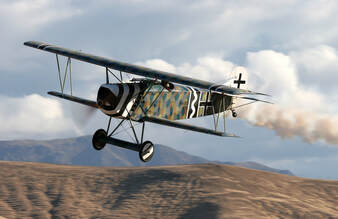
The British are flying a combination of Bristols, RE 8s and other planes, while the Germans are in Fokker DrI's and a mixed bag of other fighters and two-seaters. In Game 1, the British took to the offensive in the morning patrol. Wayne, Kevin, Garrett and Mike all crashed their two-seaters with only one English crew (Stephen's) surviving. The Brits chose to attack the German airfield with bombs, but the idea backfired as one by one, the Allied planes flew into the ground (trees, buildings, and whatever else they could find) while taking out only two German planes on the ground. While the Brits hold an early 25-0 lead, they are now at a tremendous disadvantage having dusted four of their own planes in the first mission. Game 2 - the afternoon mission of the first day of the campaign - is scheduled to be run at the next Indy gaming day on February 12th.

The only other game played on December 12, 2009 was a brief, four-turn affair featuring 10 players. Wes, Wayne, Kevin, Michael and Angie flew British Camel 130's against the Albatros DVa's of Stephen, Ethan, Rick, Mike Sr. and Garrett. The mission produced no kills although Wes' Camel pilot and Garrett's Albatros jockey were both forced to flee for home. The game was called after four turns in order to leave sufficient time for the first game of the new campaign. 

January 16, 2010 Gaming Report
Outnumbered French Fight Germans to a Draw
Americans Lose Balloon to Attack, Top Ace to Retirement

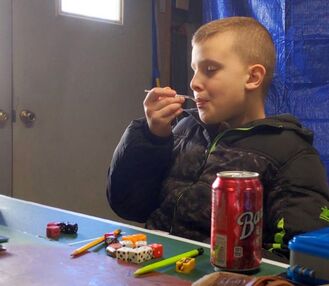
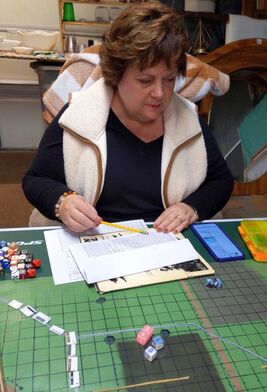
The first gaming day of 2010 started with a whimper when an unevent, April 1917 mission was rolled up. The random mission scenario called for a trio of French Nieuport 17's (Mike Sr., Michael, Angie) to tackle five Germans - one Albatros DIII (Kevin) escorting four Roland CII's (Stephen, Wes, Wayne, Garrett). This game had potential to be very interesting had time permitted its conclusion. Several young Dawn Patrol players were involved, and several additional interruptions slowed the game to a crawl. After three turns it became apparent that we needed to call it in order to have a second game at all. All parties survived and no notable events occurred, except that Ltn. Buzza Dudlegorf (Kevin, 12/2) joined the ranks of ace/experienced pilots by surviving the mission. Vz. Hasso Tinglestad (Stephen's German two-seat pilot) logged his 12th mission as well in a Roland CII. In the sparse and casualty-ridden world of two-seater crews, that's something of an accomplishment. 

The day's second and final game was everything that the first one wasn't... exciting and action-packed almost from the initial turn. Three American SPADs (Kevin, Michael, Stephen) tried to defend their balloon from attack by four Germans (the Pfalz DXII's of Sierra and Mike Sr., Wesley's high compression Albatros DVa and Wayne high compression Fokker D7 160). The lengthy, 13-turn dogfight began with the Germans flying straight through the American cover flight - or at least, as straight as possible, since the SPADs were firing at anything that moved. Kevin (Lt. Michael Jamison, 9/4) was cursed with abominable shooting, but Stephen's American ace (Major Harold Clark, 22/26) managed to pepper Wayne's Fokker with a boatload of engine hits. Wayne had no choice but to turn around and abandon the balloon mission after only three turns. Stephen's ace dared not leave his flight to close the kill since the balloon was still in danger. The remainder of the German flight to slipped through to the balloon without sustaining any additional casualties or critical hits. 

Wesley and Sierra made quick work of the balloon. Attacking in unison from close range and good positioning (without coaching!) they pummeled the gasbag with 12 rounds in their first and only pass, Wes scoring 4 hits in his Albatros and Sierra adding 8 more in her Pfalz DXII. The balloon flamed instantly with the credit going to Sierra's pilot.

With the balloon dropping in flames, the Allied flight attacked once again. Mike Sr. and Kevin got into their own private battle, with Kevin receiving a critical hit that smoked his engine. He also jammed a gun and couldn't shoot the ocean on a clear day (at one point missing 4 of 5 consecutive 100 foot shots!), rendering him entirely useless as an offensive weapon. Still, his tenacity kept Mike Sr's Pfalz DXII at bay.

To this point the Germans had flown extremely well and accomplished their mission. But Wayne's demise had take away their numerical advantage. They were also some 45 squares behind Allied lines. And at this point, the Germans made a critical mistake - they attempted to outrun the SPADs rather than turn to fight them. The German flight lost initiative and made a bolt for the the front lines, turning tail to the enemy and failing to box. Stephen's ace and Michael's SPAD pilot jumped on Wesley's high compression Albatros, which surprised everyone with its improved performance. Although he put up a great fight, nothing outruns a SPAD. Stephen and Michael tailed the Albatros for three turns before its wings fell off, with the credit going to Harold Clark (Stephen) as his 24th victory. Wesley's pilot, Edmund Reinhold (6/1), was killed in the crash.

While Michael split off to join Kevin's SPAD in his attack on the Pfalz DXII of Mike Sr., Stephen's SPAD pilot continued his assault on Sierra's Pfalz. He fired four times from the tail, chasing Sierra all the way to the front lines and wounding her pilot, before sawing off a wing. Sierra's wounded pilot failed the bailout attempt and died as Harold Clark's 25th victim. Kevin, still seeking a fifth kill for his 9/4 American SPAD pilot, couldn't have had much worse luck.

While Michael lost initiative and Kevin dealt with a smoking engine and gun jams, the lone remaining SPAD (Stephen) then dove onto the tail of the lone remaining German (Mike) and opened fire. A 9-hit burst from the tail, combined with the damage already inflicted by Kevin's single-gun, compelled Mike to try and save his pilot by force landing just inside German lines. It didn't work. His Pfalz DXII flipped over on landing in Crash #4, again killing the pilot.

This gave Major Harold Clark 3 kills and one enemy forced to escape. Wayne's Fokker would have been the fourth kill but the SPAD pilot was unable to leave his own flight to pursue the victory early in the game. He was awarded the Congressional Medal of Honor (his second) and the Citation Star (another second) in addition to two minor foreign medals available after retirement. Since Eddie Rickenbacker's 26 kills were tops for an American pilot in World War I, Major Clark is now forced to retire. More on Clark's career and retirement is found in a separate article in this issue. 


THE ULTIMATE ACHIEVEMENT
Colonel Harold Clark
Retires on Kills

Being a Dawn Patrol pilot is a death sentence. Every pilot is born to die. It's just a matter of time. But every now and then - every five to ten years or so - a pilot beats the odds and manages to outlive the game through a retirement rule so rarely utilized that many DP players don't even know it exists.

Dawn Patrol rules state that a pilot must retire once his kill total matches the highest ever historically recorded by an actual pilot in WWI. Such pilots are considered to have reached Dawn Patrol's ultimate goal - to serve to the war's end and survive the conflict as their country's most successful ace. In a game that kills 99.99% of all pilots who ever take to the air, that's about the best you can hope for. 

After playing DP for 22 years, Stephen finally reached The Holy Grail of Fitsdom when his American pilot, Col. Harold Clark, scored his 26th kill in January 16th gaming, matching the actual World War I score of Eddie Rickenbacker, America's ace of aces.

Born in Massachusetts in 1893, Clark entered service as a Lieutenant. His character first appeared in a game on December 28, 1991 in Connersville, Indiana. Over the next two decades he flew 22 missions, his final game being held on January 16, 2010.

His career started with a bang when he scored a double on his first sortie. After several relatively uneventful missions, Clark was vaulted into national prominence by scoring four straight double-mission kills, placing him atop the American category of the Dawn Patrol Ace & Experienced Pilot Roster. Throughout his career, he scored double kills on seven occasions as well as two triples. 

Clark was also lucky when he really needed a good dice roll. On December 7, 1996 Stephen was flying Clark against Graham Shepfer (DrI) and Dory Oda (D7 185) - two of Indy's all time great players with five Victory Medals between them. The engine of Clark's SPAD XIII seized over No Man's Land due to a critical hit and he was forced to glide to a landing in the front. He managed a successful landing roll and then made the sprint to Allied lines to return home. As late as March 23, 2002, on his 21st and next-to-last mission, Clark suffered 5 engine hits and a critical and barely made it home. He was equally lucky in rolling for medals and promotions. 

He was also well traveled. Clark was flown against some of the top players in Dawn Patrol all around the country. He vied for the Spring Mini Con title at Kanakakee 1992. He flew against game creator Mike Carr and Society Open champ Al Christensen at the WWI event in Boaz, Alabama later that same year. His first Medal of Honor came at a game in Dayton during the Over The Front WWI Seminar in 1993. 

There is an odd gap in Clark's career that deserves mention. He was not flown for eight years from 2002 until 2010. That is because he was fast approaching retirement and didn't want to rush into it too soon. It's not easy getting a 22-mission American pilot and retirement is not to be taken lightly. So during that time, Stephen focused on building a backup pilot (Eli Matthews) who won the Congressional Medal of Honor and became an ace but, ironically, failed to outlive the pilot he was supposed to be backing up. Clark came out of retirement after an eight-year layoff and immediately scored a triple kill, making retirement mandatory. 

But perhaps the biggest key to success in his career was his wingmen. Clark lost only three cuts-for-kill throughout his time at the front and owes many of his victories and medals to the faithful wingmen with which he flew. Those wingmen knocked many a Hun off his tail, scored many hits into airplanes that will go down in Dawn Patrol records as Clark's kills, and they are an indispensable part of his legacy. Clark flew with nearly every long-time Indy player since the squadron's inception and each of them contributed greatly to his career. His final victory list is a credit to those with whom he flew.

Colonel Harold Clark
22 missions – 26 kills
Congressional Medal of Honor (2)
Distinguished Service Cross
Distinguished Service Medal
Citation Star (2)
Legion d’Honneur, French
Croix de Guerre with palm, French
Distinguished Flying Cross, British
Croix de Guerre, Belgian


Famed War Diary Now In Print
Private Beatson's War from Pen & Sword Publishing

In May 2006 the war diary of Private James Beatson of the 9th Battalion, Royal Scots went up for sale at Sotheby's auction house. It was one of two diaries kept by Private Beatson during his tenure on the Western Front of World War I. Of the many thousands of diaries that survived the war, this one is particularly intriguing because the second matching diary was lost forever when its author was killed in action in July 1916, just days before his 24th birthday. 

Private Beatson saw the war that modern readers can only imagine. He wrote of it frequently, sparsely, and with telling words that survive in the new book from Pen & Sword Publishing of England. "Private Beatson's War" is particularly easy to read. Beatson's entries were brief and to the point. His observations are written with a flair for entertainment as seen through the eyes of a 23 year old youngster. This book will tell you more about his personal life and his adventures and experiences that it will the Battle of the Somme in which he died, but that is the beauty of the book, not its shortcoming. 

The editors have selected an outstanding variety of photos for the book, all of them reproduced with great quality and clarity. A few are somewhat common, but many of them are rare gems. For those just beginning to study the war to end all wars, this book is a personal experience that cannot be beat. Its simplicity, straightforwardness and brevity make it enjoyable. Its maps and footnotes make it understandable. Its photos and emotions make it real. "Private Beatson's War" is a great addition to any WWI library and is recommended. 

PRIVATE BEATSON'S WAR
www.pen-and-sword.co.uk
19.99 British
154 pages
ISBN 184884082-9


Indy Squadron Dispatch Staff
Squadron Treasurer: Rick Lacy
Editors Emeritus: Brian Halberstadt, Terry Phillips
Editor-in-Chief: Stephen Skinner
Credits, Volume 21 Number 8: Indy Squadron Archives
Visitor Counter Parameters: Counts unique visitors only per two-hour period.
Does not count reloads, seperate page visits, or subsequent guest visits within two hours.
All content is copyright IndySquadron.com/Indy Squadron Dispatch, 1989-2009, and may only be used or reprinted by permission.
This site is best viewed with Mozilla Firefox browser.


Visit IndySquadron TV

Support Proxify below - the leading proxy server system for privacy and security

defeat proxy server

Subscribe to Dawn_Patrol
Powered by games.groups.yahoo.com

This site is a member of WebRing.
To browse visit Here.